From Dawn to Horizon
Dawn was Shopify’s default theme for years and the base of countless stores. With Horizon, Shopify introduced a new generation of themes built around theme blocks: small, reusable building blocks that you combine and nest freely in the editor. Those building blocks are also what make themes workable for AI agents.
Sidekick builds blocks for you
In themes whose sections accept theme blocks, you describe what you need in the theme editor in your own words. Sidekick generates the Liquid code, including the HTML, styles and editor settings. A countdown for a sale, a comparison table or a delivery notice no longer needs a developer. According to Shopify, the feature is available to eligible merchants.
Canvas: the whole store on one surface
The Fall ‘26 Edition adds Canvas. You see your store as a whole, zoom into individual areas and let Sidekick make changes right there. According to Shopify, Canvas can also be used from AI assistants.
AGENTS.md and DESIGN.md: context for agents
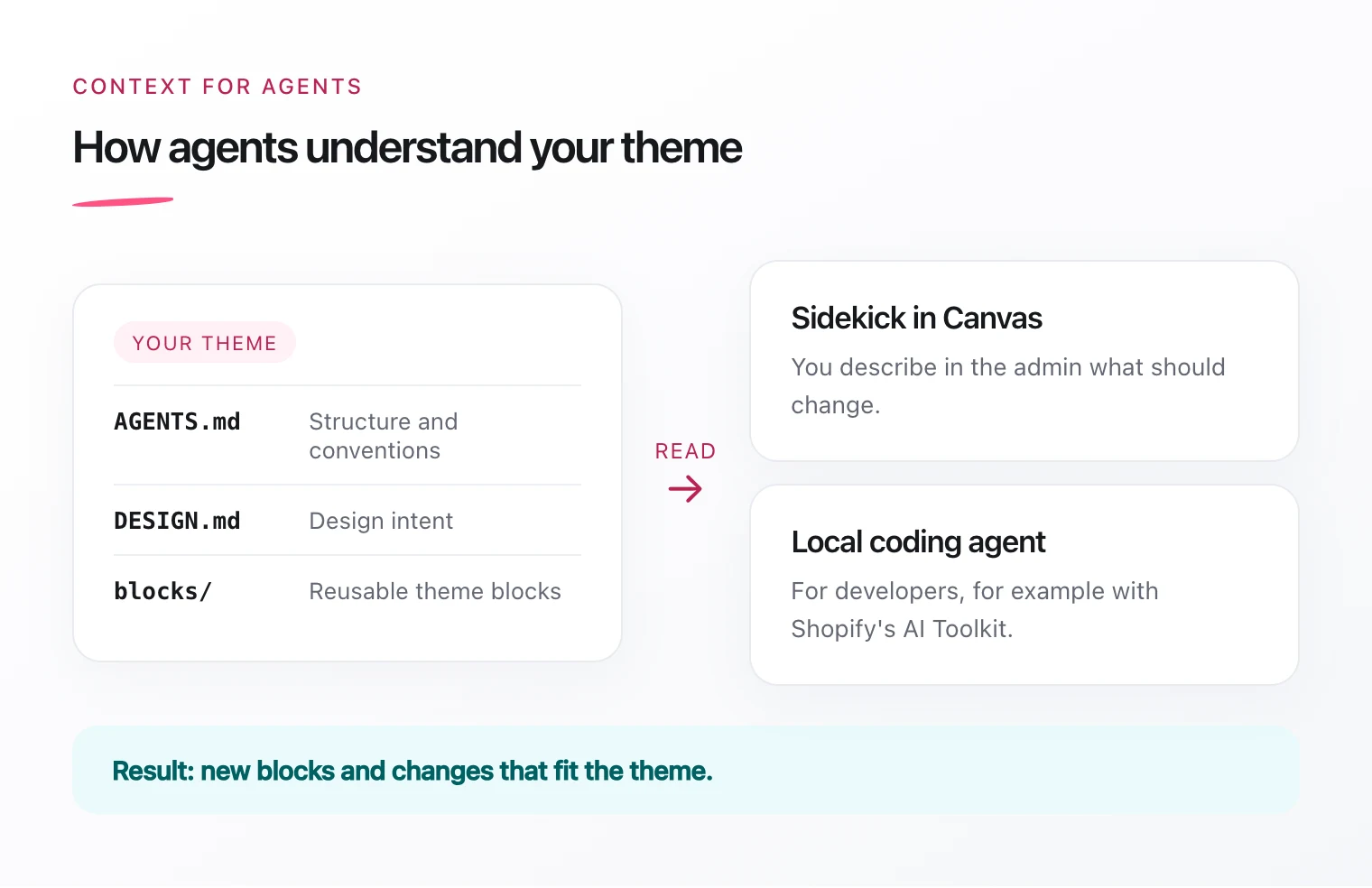
To help an agent write code that fits, not just code that works, themes can include two Markdown files at their root:
- AGENTS.md explains how the theme is built, which conventions apply and which patterns the theme avoids on purpose.
- DESIGN.md records the design intent, so new building blocks match the existing design.
Sidekick reads these files before it changes a theme in Canvas, and it can update DESIGN.md when you ask for stylistic changes. Coding agents that support the AGENTS.md format read the same files when you work on the theme locally. Your customers never see them; Shopify does not serve them on the storefront.
The next generation of Liquid
For developers, Shopify released a developer preview in July 2026. With the new {% block %} and {% partial %} tags, the structure of a page lives right in the Liquid template, where developers and coding agents can read and edit everything in one place. Partials can be refreshed with JavaScript without reloading the whole page. According to the Fall ‘26 Edition, typed contracts between blocks and built-in Tailwind are part of the new architecture too. It is still a preview and not meant for live stores.
What it means for your store
- You build small pieces yourself: a banner, an FAQ or a delivery notice often won’t need a developer any more.
- Quality is still handwork: generated code works, but it is not automatically fast, accessible and safe to update. The more blocks an agent generates, the more a clean structure matters.
- A custom theme becomes realistic: with well-maintained AGENTS.md and DESIGN.md files, a custom theme comes together faster and stays consistent. It no longer has to be Dawn plus customisations.
- Build new themes agent-friendly: theme blocks instead of rigid sections, clear conventions and a documented design.
How I work with it
I build with AI agents myself, including Shopify’s AI Toolkit. It connects coding agents to current Shopify documentation and validates Liquid and GraphQL against Shopify’s schemas. The agent writes faster; I decide on structure, performance and quality.